Last month, the island of La Réunion became the meeting point for tea cultures from around the world as it hosted the inaugural International Tea Symposium (ITS 2026), a landmark event dedicated to tea as a living cultural heritage and a vehicle for dialogue between peoples. Organized under the High Patronage of the Presidency of the French Republic and with the support of the UNESCO Community Association, the symposium brought together producers, researchers, institutions, artists, and tea experts from multiple nations and tea-growing regions.
Held on 21 May, International Tea Day, the event was conceived as a tangible expression of the United Nations initiative established in 2019 to recognize the economic, social, and cultural importance of tea worldwide. Rather than simply celebrating tea, the symposium sought to create a permanent international platform where heritage, science, sustainability, and culture could meet.
Why La Réunion?
The choice of La Réunion was far from symbolic. Located in the Indian Ocean and renowned for its UNESCO-listed landscapes, the French overseas territory has historically served as a crossroads between Asia, Africa, and Europe. The island also holds a little-known place in tea history: as early as 1729, it was among the first French territories to experiment with tea cultivation and acclimatization.
For this inaugural edition, the Republic of Korea was designated Guest of Honour, a decision that coincided with the 140th anniversary of diplomatic relations between France and Korea and highlighted the importance of cultural and scientific exchanges between tea-producing nations.
Tea Beyond the Cup
One of the most remarkable aspects of the symposium was its multidisciplinary approach. Far from focusing solely on production or consumption, discussions explored tea through multiple lenses, including cultural heritage, education, sustainable agriculture, climate change, women’s roles in tea culture, sensory science, artistic traditions, and intercultural dialogue.
The event featured conferences, tastings, scientific exchanges, institutional meetings, and cultural initiatives, reinforcing the idea that tea is not merely an agricultural commodity but a shared cultural asset connecting societies across continents.
“Tea as a Common Heritage”
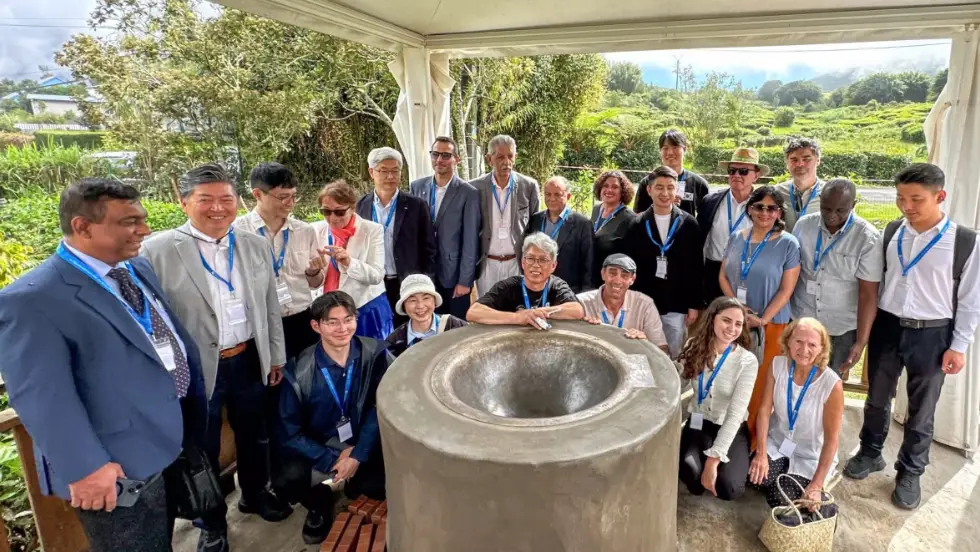
Among the most powerful initiatives unveiled during the symposium was Tea as a Common Heritage, a collaborative project involving the UNESCO Community Association, the French Tea Producers’ Association, and Korea’s Hadong Tea Producers’ Association. At the heart of the project stood the Tea Wok, a symbolic collective artwork built around the principle:
“One country, one brick. One humanity, one heritage.”
Each participating nation contributed symbolically to the construction, affirming tea as a universal heritage and a force for peace, transmission, and collective responsibility. The project also highlighted the preservation of the ancient Korean tradition of tea wok craftsmanship, a knowledge passed down for more than 1,200 years in the Hadong region. By elevating this artisanal practice to an international stage, the symposium underscored the idea that safeguarding tea heritage is a shared global responsibility.
A New Scientific Approach to Tea
The symposium also demonstrated how tea continues to inspire innovation and research. Through the ITS 2026 Sensory Lab, organized in collaboration with the École Supérieure du Parfum et de la Cosmétique (ESPC), the University of Versailles Saint-Quentin, and the Hadong Tea & Bio Foundation, students and researchers conducted advanced sensory analyses of Korean teas. Using methodologies traditionally applied in the fragrance industry, participants mapped aromatic families and developed structured olfactory profiles linked to specific terroirs.
The initiative represents a significant step toward bringing tea sensory evaluation to a level of rigor comparable to that of wine and perfume, opening new possibilities for the characterization and promotion of tea origins worldwide.
Looking Ahead to Japan 2027
As the symposium concluded, organizers announced that the next edition will take place in Japan in 2027, launching what has been called the Relay of the Tea Nations. Borrowing from the symbolism of the Olympic torch, the concept envisions each host nation passing the flame to the next, creating a continuous international dialogue around tea culture and heritage.
For the hospitality industry, the significance of the International Tea Symposium extends well beyond tea itself. As luxury hotels, resorts, tea houses, and fine dining venues increasingly seek authentic cultural experiences, initiatives such as ITS demonstrate how tea can serve as a bridge between tradition, sustainability, education, and tourism.The first International Tea Symposium may have taken place on a remote island in the Indian Ocean, but its ambition is unmistakably global: to position tea not only as a beverage, but as a shared human heritage worthy of preservation, study, and celebration.